
May 13, 2015:
Intro Elaine Fine, Karen Avrich
Intro Carol Jochnowitz
on Howard Zinn
on Exile, Corliss Lamont, Helene Williams et al
Feb., 1934 NY Press Conference
on Elie Siegmeister, Eleanor Roosevelt, Lenin
12/6/87 Overture & Credits
Intro LivingThtr EG perf
5/1/07 My Marriage, Lenin
Intro E.G. Russian Scene w/Emily R. Lehrman
6/27/94 E.G. Russian Scene w/Emily R. Lehrman
Intro E.G.'s 1stSpeech, Monolog, Song
E.G.'s 1stSpeech, Monolog, WhereDoIBelong?
7/14/02 Wedding Credits (over "WhereDoIBelong?")
Intro Berlin ComeTheRevolution
5/4/86 Berlin ComeTheRevolution - Berlin Qt
on ComeTheRev & MaynRuePlatz
MaynRuePlatz, arr. Fine
Intro Fedya
Fine: Emma & Fedya
Intro E.G. "Sex?" & Triangular Love Duet
12/6/87 Sex?
12/6/87 Triangular Love Duet
Intro Fathers & Sons
4/23/87 Fathers & Sons
Gary Kuleisha: Helen Minkin
Intro Ben Reitman Scenes
Fine: Ben & Emma
E.G. Ben Reitman Scene
5/1/07 Isadora & Sasha
E.G. Convictions
Fine: Refuse!
Intro to E.G. Act I Finale
12/6/87 E.G. Act I Finale
Audience Reaction +Elaine Fine
Karen Avrich
Margie Barab on E.G. & Hillary
Emma Goldman & Music
12/27/91 Candace Falk in SF
5/1/07 Susan Blake, Helene & Leonard
for female singer & male singing pianist
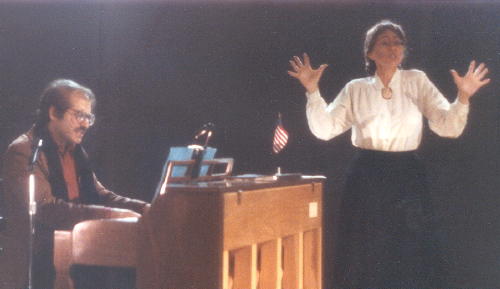
90' (2 acts) 22 numbers
alt. versions titled Emma Goldman in Exile or Scenes from the Life of Emma Goldman
for 3 female & 3 male singing actors (130') (2 acts, incl. more dialogue & ensembles)
book & lyrics with Karen Ruoff Kramer (except 7 numbers by composer alone)
music by Leonard Lehrman, op. 78
Revival with Caryn Hartglass in the title role:
Sun., Oct. 26, 2025 4pm at Puffin Cultural Forum, 20 Puffin Way, Teaneck, NJ
[Watch trailer here.] and at Theater for the New City, 155 First Ave., Manhattan:
Jan. 9 (8pm), 10 (8pm), 15 (8pm), 18 (3pm), 23 (8pm) & 24 (8pm), 2026
A complete composite of the last two performances, subtitled, + Q&A from those evenings,
is posted as a playlist, here.
An album of photos taken by Jonathan Slaff at Theater for the New City is posted here.
Crystal Field, having attended the Jan. 8, 2026 premiere of the TNC production of E.G. wrote:
"Thank you for a charming and enlightening evening.
I thought I knew all about Emma Goldman but I certainly found out that I didn't.
The Music and singing was wonderful."
Podcast discussion with Andrew Cortes, "Whisper in the Wings," Jan. 4, 2026
Reviews:
"Leonard Lehrman's Sima and E.G.: A Musical Portrait of Emma Goldman:
Two Operas, One Warning: History's Unfinished Fight for Dignity, Justice, and Humanity",
by Chris Ruel, 3 February 2026, OperaWire:
"E.G." is an intriguing work, blending elements of an opera, a stage play, and a one-woman show, with a hint of Broadway in the score.
It seems straightforward: visa application questions answered through song and spoken word. But under the hood, the structure is complex. Each response included, on average, three songs. And those pieces were often sung by four or five different characters. For example, the final number for DEPENDENTS has five: E.G., Johann Most, Alexander Berkman (Sasha), Fedya, and Ed Brady.
Yet there were only two people on stage. How did they do it?
One Person, 15 Characters
Lehrman played 15 different characters, ranging from V.I. Lenin to the artist Modest Stein (nicknamed Fedya), all from the piano, using hats as markers for each role. The images of the real people were projected onto a screen so the audience could always recognize who Lehrman was portraying.
The composer's main character was Alexander Berkman (Sasha), a well-known anarchist who stood on a similar revolutionary level as E.G. Both were deeply connected intellectually and emotionally, forming a very close pairing.
Within the opera, E.G. and Berkman engage in banter to provide background. If these conversations are not followed by songs, E.G., in a soliloquy style, speaks about the topic at hand. During the banter, Lehrman was the opera's comic relief, putting on hats and speaking using numerous accents. He often interjected something humorous during the E.G.'s soliloquies. It was akin to running color commentary.
The voices and accents, the humor, and the quick character shifts were Olympic-level.
Overall, the opera's entire structure was clever and highly effective.
Soprano Caryn Hartglass played the title role as E.G., delivering lines with some operatic singing blended in.
A test of an actor's ability is how well they suspend disbelief. I didn't see Hartglass; I saw E.G. To me, that's one of the highest praises you can give an actor. I was thoroughly engrossed by Hartglass's performance. The gears were turning as I thought about Goldman and her world, and how closely it mirrors ours.
Protests are happening across the United States and are being met by state-sanctioned violence. There are martyrs. There's a heavy-handed Department of Justice. The rights of women, workers, and those the government has determined to be "political enemies" are being trampled upon. It's sad and terrifying, but, honestly, it's nothing new.
"Bringing Her Home
Composer Leonard Lehrman on the Decades-Long Journey
to Get 'Sima' its NYC Premiere",
by David Salazar, 22 January 2026, OperaWire:
"E.G.: : A Musical Portrait of Emma Goldman" was written in the 1980s and has been the most performed of Lehrman's 272 works, with 44 productions in five countries. Lehrman was inspired by a play by Howard Zinn and chose to focus the opera on Emma Goldman's attempt to get back to America, having been deported by J. Edgar Hoover. What makes this one unique is that the production, headlined by Caryn Hartglass, also features the composer himself undertaking several roles at the piano.
"It's very thrilling," Lehrman told OperaWire about performing his own work. "Watching someone else do it can be lovely too, but at least half the time I feel the way Ned Rorem did, listening to someone else accompanying his songs" he'd rather be doing it himself.
"I'm performing all the men in Emma Goldman's life, and Caryn Hartglass has devoted herself, body, soul, and voice, to the title role in a way any composer could envy," he added.
This marks the first time "E.G." is done in New York City since 2007.
"The success of E.G. has been phenomenal," Lehrman concluded about the ongoing production.
"Ed Malin reviews E.G. a Musical Portrait of Emma Goldman", Hi! Drama, 19 January 2026. (cached)
Emma Goldman, famous 20th Century anarchist, had a lot to say about disturbing trends in American government, which remain relevant today. The bonus that you get in the musical version by Leonard Lehrman and Karen Ruoff Kramer is the story of Emma's love affairs.
Whatever you might know about Emma, come see this exciting show. It has been performed around the world. This production (running at T.N.C. in repertory with Sima) features Caryn Hartglass as Emma and Lehrman as solo pianist as well as playing all of the rabble-rousing men in Emma's life.
Many of us might be forgiven for thinking that Emma Goldman's anarchist activities peaked in 1917, when she and her lover Alexander Berkman were arrested for protesting the World War I draft. Berkman went to prison (again) and Goldman was deported to her native Russia. By 1933, with apologies to fans of Mussolini and other dictators, the world was in even worse shape than in 1917. At this most interesting moment, Emma was given a visa by the U.S.A. to come back for a lecture tour. Lehrman strikes up a rousing tune to follow Emma's visa application process. All the history, all the defiance, all the romance are nicely framed in this moment.
We hear about the good old days in the late 19th Century. Emma comes under the sway of radical journal publisher Johann Most, as well as Berkman, who makes anarchism sexy. Doctor Ben Reitman sells her on the idea of free love. Agitating in the U.S.A. makes her famous. Back in Europe, she heads for the Spanish Civil War.
Caryn Hartglass is indeed a powerful presence. She brings to life a figure who for 70 years did not stop fighting for the rights of the people. Lehrman's music and charming narration show great devotion to this history.
"Life on the Outskirts of Society" review by Beate Hein Bennet, New York Theatre Wire, 18 January 2026:
"E.G." is definitely a star vehicle for superb Caryn Hartglass who presents the character of Emma Goldman as a formidable but engaging woman. While the chosen archival photographs of the historical E. G. project a rather dour looking woman with no apparent sense of humor, except for one photo of a young pretty Emma with a slight smile, Ms. Hartglass plays her with wit, grace, and an insouciant charm that makes her many love affairs quite credible. Also admirable is her vocal range and expressiveness that makes the mostly sung text feel natural to her character. She engages with the series of male characters in her life portrayed by Mr. Lehrman at the piano. He simply dons a different head cover, such as different yarmulkes, caps, and hats, or a scarf around his neck to indicate the various personalities. He is lively in his presence and obviously relishes playing the diverse characters, especially the lovers. It is a delightful portrayal of a complicated character in complicated times.
"Emma Goldman, superstar? The Jewish anarchist has a surprising role to play in American musical theater",
review by PJ Grisar, The Forward, 9 January 2026.
Critique by Joel Mandelbaum, 19 January 2026:
I found your creation and production unique. You have mused about whether to consider E.G. an opera or a musical. It is both, in part. The "set pieces" are in the style of a musical and the tunes are in the popular vernacular and attractive. The much longer portions that connect the tunes are in classical operatic style often employing modern harmonies. The fact that a single piano is used to accompany both the set numbers and the connecting passages somewhat obscures the great differences in what a listener associates with the various parts.
I love the ambiguityÉ which also seems appropriate for the depiction of an historic figure whose lifetime work escapes categories. The very thorough research into the details of the life of Ms. Goldman makes the presentation a valuable history lesson for the audience, and leaves an impression of her character and concerns more vivid than one would get from a lecture or a book. Emma Goldman lives in your presentation---when one has seen E.G. one will carry the impression you and your excellent singer, Caryn Hartglass, convey.
Opera or non-opera: Certainly the part of Ms. Goldman, superbly sung by Ms. Hartglass, was operatic in full, even if some of her set pieces resembled a more vernacular genre. What about the other part or parts? They were sung (all of them and there were quite a few) by the composer, Leonard Lehrman. His performance, in the role of her associates, many of them also lovers, was essential to the production and hard to imagine transferable to another performer.
In his autobiography, Lehrman mentions an audition to become a conducting student of Tibor Kozma. Part of his audition involved singing a few notes.
"Of course, I'm not a singer" Lehrman says, to which Kozma replies "no keeding." Part of the amazing, as well as unique, effectiveness of Lehrman's performance, is that both Lehrman and Kozma are right, Lehrman is no singer by the customary expectation of the field. But his notes are correct, he projects the words and the attitudes each character is trying to convey. For a story about Emma Goldman based on the premise that she is, by a huge margin, the central figure in her own life, the fact that there is no pretence to vocal sublimity in any of her various co-workers is a virtue.
Except for a cameo role for an interpreter [Geoffrey Carlson] during a brief scene in Russian, there are only the two performers, even though there are (literally) many hats to be worn by Lehrman as he impersonates many characters. The starring role of Ms. Goldman is a grand vehicle for a singer who excels in multiple styles. It has carried at least three brilliant singers [Elizabeth Parcells, Helene Williams, and now Caryn Hartglass] through dozens of performances.
The role of pianist/singer of all the male roles in Ms. Goldman's life has been sung by only one, Dr. Lehrman himself. The sheer number of performances and the positive response to them suggest a possibility for eventual canonic status for this work. The clear pivot point would be the placement of another pianist/vocalist in the role now played by Dr. Lehrman. Can it work without the actual composer's participation?
Clearly, the impression drawn is that Goldman was a woman so self-centered that the men in her life were almost interchangeable. Since I think that this is probably true, I found this unique two-person presentation brilliant, revealing, and quite special. And, as far as I can tell, there is nothing quite like it ...in any genre.
->Most recent manifestations:
Complete, Edited & Subtitled (2021) Performance Video of Dec. 27, 1991
at Noe Valley Ministry, San Francisco
Video by Marvin Lehrman - without Projections
with Candace Falk in the Q&A afterwards
"Haymarket" excerpt from newly subtitled video played at May 4, 2021 Zoom concert
Closing Presentation at June 27, 2019 Sesquicentennial Celebration:
"A Revolution Worth Having",
University of Michigan at Ann Arbor:
Playlist
Carillon performance of "Where Do I Belong?"
Introduction to Closing Presentation
Feb. 1, 1934 NY Press Conference
Video
Audience Reaction to Film
Presentation:
Productive, Loose & Dead Ends, Researching Background for Performing Emma Goldman Onstage,
including Russian Scene and "Where Do I Belong?" (a cappella) +Q&A
Videos of 1993 interviews posted in conjunction with 2019 celebration:
with Arthur Bartel (Attilio Bortolotti) & his wife Libera, Toronto
with Marie Tibaldo (1903-2007), Toronto
with David Diamond (1915-2005), Rochester, NY
June 28, 2019 "A Recital for A Radical," First Unitarian Society, Madison, WI
first half, including Emma Goldman portion, unfortunately unfilmed
- included title song, Russian Scene, "Where Do I Belong?"
and "If I Can't Dance," danced with Drew Collins
performances of Russian Scene in Moscow:
Nov. 1, 2016 US Embassy
Nov. 3, 2016 Russian University for the Humanities
Lecture on Emma Goldman Operas, May 13, 2015
at Community Church of NY. Click
here for playlist. Details & individual links at bottom of this page.
Endorsement: "[an] extraordinary commemorative event...
The evolution of your talented, finely-honed musical skills,
working with the accomplished Helene, is a pleasure to behold.
Thank you also for honoring me and the work of the Emma Goldman Papers
woven in and out of the narrative, including my commentary (in the dark!).
It's quite amazing how many years we've spent on all this.
Seeing the youtube of your event reminded me that I am not alone in this devotion,
and we have all added a creative flair to the historical (and musical) record through our work.
I'm glad you brought so much of it together. Bravo, and thank you!
Solidarity and love and all that. Emmasaries of the World Unite!"
--Candace Falk
Performances watchable on YouTube:
Benefit for U.S. Americans for Peace, West Berlin, May 4, 1986,
on the 100th anniversary of the Haymarket Riot,
featuring soprano Elizabeth Parcells with Leonard Lehrman at the piano.
Go to playlist here, or click on individual excerpts:
Introduction & Overture -
Scene 1 & Title Song -
Russia - America -
Haymarket -
Where Do I Belong?
Quartet: Come the Revolution
[also with Frohwalte Pilz & Uwe Sauerwein]
Act I Finale
["I Believe," "The Judith Dream," and "If I Can't Dance, It's Not My Revolution"]
Fathers and Sons -
Ben Reitman Scene
Act II Finale
[including bow by co-author, Karen Ruoff Kramer]
premiere of 6-person version, Libertarian Book Club, April 23, 1987
with Helene Williams, Pamela Sanabria, Sheila Dean Wormer
Douglas Kiddie, Don Catrone, Eugene Green, and the composer at the piano
Go to playlist here, or click on individual scenes and songs:
Overture & Credits -
E.G. (title song) & opening scene -
Descartes, My Marriage -
Denaturalization
Russia - America -
Haymarket -
Emma's First Speech -
Where Do I Belong? -
Come the Revolution
Act I Finale: I Believe, Judith, If I Can't Dance -
Entr'acte & E.G. Reprise
Interview with Consul Horatio Mooers -
Sex -
Triangular Love Duet
Fathers & Sons -
Emma & Sasha -
Ben Reitman Scene -
Education, Vaudeville, Occupation -
Convictions
Nicaragua, 1929 -
A Woman Without A Country -
Press Conference, NY, Feb. 1, 1934 -
Act II Finale
Jewish Currents concert performance of 6-person version, Dec. 6, 1987
with Helene Williams, Pamela Sanabria, Sheila Dean Wormer
Douglas Kiddie, Mark Hoeler, and Eugene Green, with the composer at the piano
Go to playlist here, or click on individual scenes and songs:
Introduction by Isobel Pearlman -
Introduction by Leonard Lehrman
Overture & Credits -
E.G. (title song) & opening scene -
Descartes, My Marriage -
Denaturalization
Russia - America -
Haymarket -
Emma's First Speech -
Where Do I Belong? -
Come the Revolution
Act I Finale: I Believe, Judith, If I Can't Dance
Act II Introduction by Leonard Lehrman
Entr'acte & E.G. Reprise -
Interview with Consul Horatio Mooers -
Sex -
Triangular Love Duet
Fathers & Sons -
Emma & Sasha -
Ben Reitman Scene -
Education, Vaudeville, Occupation -
Convictions
Nicaragua, 1929 -
A Woman Without A Country -
Press Conference, NY, Feb. 1, 1934 -
Act II Finale
most recent complete NY performance at The Living Theatre, May 1, 2007,
presented by The Libertarian Book Club,
starring Helene Williams with the composer at the piano,
Susan Blake at the projector, and Carol Jochnowitz at the lightboard,
videotaped by Bill Castleman. Performance dedicated to the memory of Paul Avrich.
Go to playlist here, or click on individual scenes and songs:
Introduction, Overture, Scene 1 and Title Song
Marriage, Lenin, Haymarket
Where Do I Belong? & Come The Revolution
Act I Finale
["I Believe," "The Judith Dream," and "If I Can't Dance, It's Not My Revolution"]
Entr'acte, Sex, Fathers & Sons
Ben Reitman Scene -
Isadora [Duncan], Sasha [Berkman], Roger [Baldwin]
Convictions, Act II Finale
[Anarchism, Birth Control, Conscription Resistance;
"E.G.", "If I Can't Dance, It's Not My Revolution," "I Believe," and "Come the Revolution"]
Emma Goldman in NY, 1934 (press conference)
Discussion at The Living Theatre
with Leonard Lehrman, Helene Williams, Susan Blake, Bill Castleman, Judith Malina, and others.
excerpts performed at Halifax Summer Opera Workshop, July 28, 2012:
Introduction - Leonard Lehrman
Where Do I Belong? - Helene Williams
If I Can't Dance - Rachel Wood, Allison Mills, Laura Noack
other excerpts:
"Come the Revolution" performed
Aug. 8, 2010 by Leonard Lehrman, Helene Williams, Faith Steinsnyder & Charles Osborne
Dec. 2, 2012 by Leonard Lehrman, Helene Williams, Hannah Spierman & Benjamin Spierman
"Where Do I Belong?" performed by Helene Williams
June 17, 2010 (in memory of Howard Zinn);
Nov. 20, 2011;
Apr. 1, 2012
together with "If I Can't Dance" at Municipal Auditorium of Sighet, Romania Oct. 17, 2019.
"Russia - America" (Scene with Lenin, in Russian) performed
4/23/87 Libertarian Bk Club, 12/6/87 Jewish Currents, 6/27/94 LIU-Post w/Emily Lehrman,
5/1/07 Living Theatre w/Susan Blake, 5/30/16 Court Street Music, 6/16/16 Vitebsk;
11/1/16 US Embassy, 11/2/16, Skryabin Museum, 11/3/16 University for the Humanities, Moscow, Russia.
"If I Can't Dance" performed by Kathryn Wieckhorst in Hamburg, Germany,
May 26, 2018, dancing with the composer (for the first time)!
Russian Scene & "Where Do I Belong?" June 27, 2019 Univ. of Michigan, Ann Arbor (see above)
Same +title song & "If I Can't Dance" June 28, 2019 First Unitaritan, Madison WI (see above)
"Where Do I Belong?" at Tuttle Center, Jan. 12, 2020, in memory of Emily Lehrman = posted here.

previewed by US Americans for Peace and at Stanford University in Berlin 5/86
completion commissioned by Bel Canto Opera Workshop et al, 1986-87
1987 performances: 3/29 Herbert Liebman Memorial Concerts, Vladeck Auditorium (Bronx);
3/24 WBAI (Cynthia Bell), 3/30 WEVD (Ruth Jacobs), 3/31 WNYC (Andre Bernard) interviews;
4/23 Libertarian Book Club @Workmen's Circle Branch (Manhattan)--attended by Paul Avrich;
5/3 Alchemical Theater (Manhattan) [afternoon & evening];
8/87 Reynolds Hills, Buchanan NY;
10/12 Cornell University (Barnes Hall); 10/14 SUNY-Cortland;
Fine Arts Museum of Long Island (Hempstead) [photo by N.S. Lehrman, above]; Jewish Currents Concert
1988 4/16 WCWP interview (Shirley Samberg)
1989 performances: 3/16 Temple Emanuel (sponsored by University of Lowell), Lowell, Mass.;
3/17 Boston University; 3/18 Harvard College (Adams House)[+WHRB interview w/David Elliott];
3/19 Community Church of Boston;
3/20 Brandeis University Festival (The Tower)--attended by Howard Zinn
1990 performances:
2/8 Columbia University--attended by Jack & Nora Beeson [+2/6 WKCR interview];
2/14&15 Queens College; 3/3 Wellesley College;
5/90 WPBX interview (Barbara Goldovsky);
5/14 Excerpts at Tamiment Library, NYU, on program with Candace Falk, Gloria Steinem et al
5/15 Bryant Library, Roslyn;
5/23 WQXR's "The Listening Room" & Midtown YM-YWHA (Manhattan);
6/1 WESPAC (White Plains Unitarian Church);
6/8 International Institute for Social History, Amsterdam;
6/19 W. Berlin; 6/24 E.Berlin; 6/29 US Peace Committee Paris; 11/9 Dartmouth College
1991 performances: 2/9 Ethical Culture Society of N.Y. City;
3/15 Excerpts at Tarrytown Town Hall, on program with Connie Hogarth,
Amy Goodman, Pete Seeger, Michio Kaku and Ramsay Clark
4/7 Peninsula Library, Lawrence, L.I.;
11/13 McCormick Auditorium, Norris Center, Northwestern University (National Opera Assn convention);
WFMT interview with Studs Terkel;
11/21 American University, Kreeger Music Building, McDonald Recital Hall - (Jewish Studies Program);
San Francisco Modern Language Association Convention - 12/27 Noe Valley Ministry, U.C./Berkeley
KPFA & KALW interview with Dennis Bernstein
1992 performances: 7/23 Alexander Berkman Conference, Pittsburgh;
11/14 UMass/Amherst Marxism and the New World Order Conference
1994 6/27 performance [program cover below]: C.W. Post College
(School of Education, Library School Student Assn, McGrath Fund)
2002 10/3 WUSB interview (George Wallace)
2007 performances:
Fri. Mar. 9, 8pm The Puffin Room*, 435 Broome St., Manhattan $15
Sun. Mar. 11, 3pm Great Neck House FREE
Fri. Mar. 16, 8pm PeaceSmiths, Amityville $8
Sun. Mar. 25, 3pm Long Beach Library FREE
Sun. Apr. 29, 4pm Puffin Cultural Forum, Teaneck NJ $5
Tue. May 1, 8pm Libertarian Book Club at The Living Theatre*, 21 Clinton St., Manhattan $10
all with Susan Blake at the slide projector, and *Carol Jochnowitz running lights

May 10, 2007 "If I Can't Dance" sung by Helene, danced with Nat Lehrman
at Morris Schappes Centenary, NYU Library, videotaped by Carol Jochnowitz
Posted (and subtitled!) here.
Also played at May 4, 2021 Zoom concert.
2009 performance:
Tue. May 26, 5:30pm FREE
Rosenwald Gallery, 6th floor, Van Pelt-Dietrich Library Center
University of Pennsylvania, 3420 Walnut St., Philsdelphia
A Celebration of The Women's Section of the
Walter J. Lear U.S. Health Activism History collection
of the University of Pennsylvania Libraries
Rare Book & Manuscript Library
and the U.S. Health Left History Center
Excerpts "I Believe," "Judith" and "If I Can't Dance"
performed at Weill Recital Hall 6/14/89
"Where Do I Belong" performed widely;
also as part of Jewish Woman in Song program
"Where Do I Belong?" (2'43") & "If I Can't Dance" (2'16") AMC
recorded by Helene Williams & composer on Songs of Conscience cassette 3/91 & CD 6/03
inspired by Howard Zinn's play Emma

[Howard Zinn with Helene & Leonard at Brandeis, 3/20/89]
David Weinstein, The Justice, 3/28/89, p. 13:
"a musical about perhaps the greatest American revolutionary ever: Emma Goldman...
just as relevant today as when Goldman first propagated her views....
Howard Zinn, perhaps the foremost radical historian/social critic in the country,
was at the Castle Commons Thursday night. So was Joyce Antler,
Brandeis Women's Studies professor. Emma Goldman was there,
sitting in a big chair and telling us about her problems getting into America.
Her lover and fellow anarchist Alexander Berkman sat next to her,
playing piano and spouting wisom. Okay, so the last two people were actors.
That's not the point. The question is: Where the Hell were you?"
David Weinstein (Jan. 10, 1967-Nov. 14, 2025) later served as a Senior Program Officer
at the National Endowment for the Humanities, which funded a PBS program on Emma Goldman, aired on April 12, 2004.
He confirmed to Leonard and to Howard that they had inspired his endorsement of the program.
also endorsed by the late Paul Avrich

[at Workmen's Circle, 4/23/87]